How Barco Agency went from SDR turnover to 34 meetings and a 30% reply rate using AI
A conversation with

Ernesto Barco
Founder
Challenge
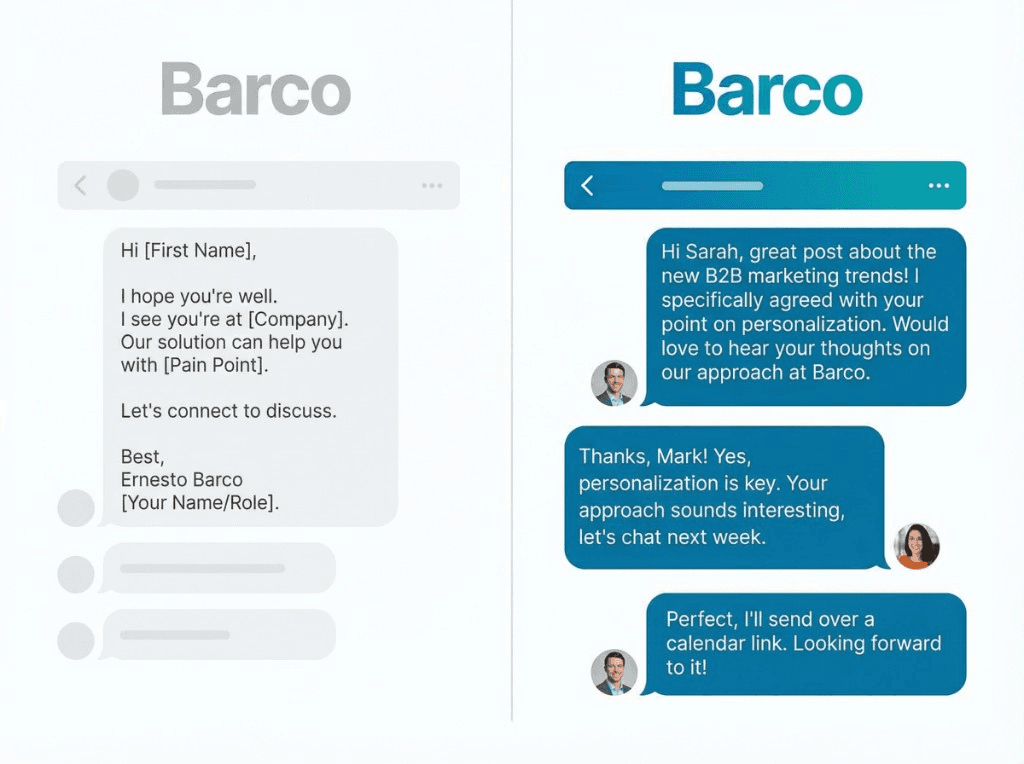
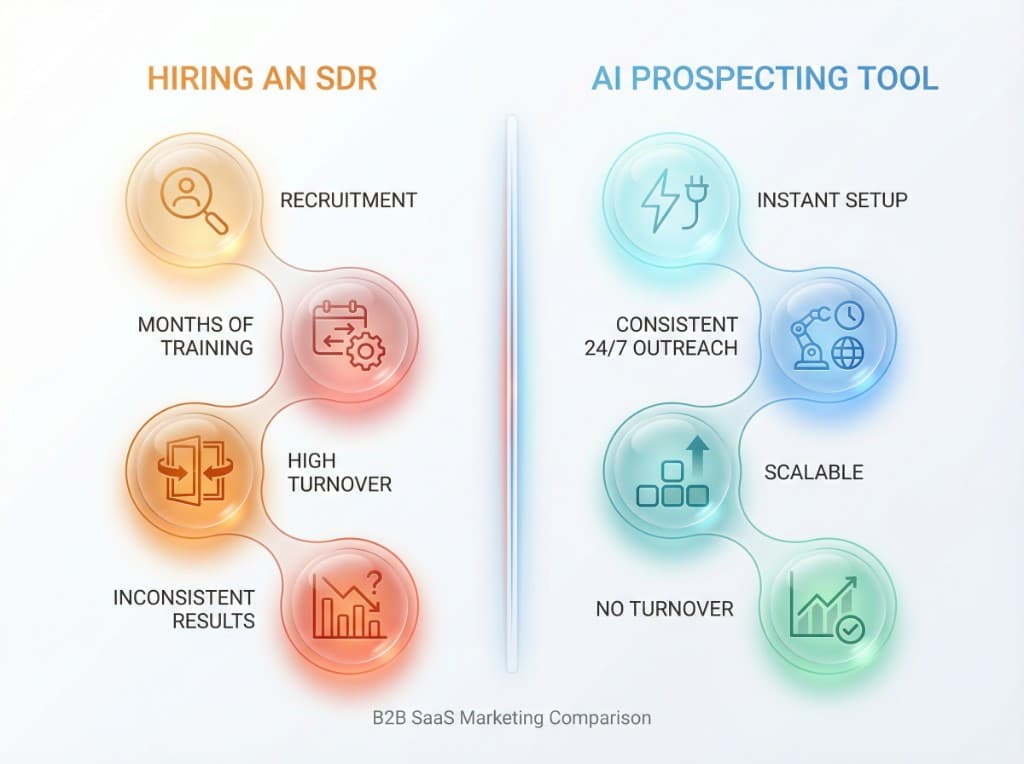
Barco Agency was using rigid bracket-based templates for mass social prospecting. Messages were generic, ending up in spam or going completely unread. The traditional SDR model meant months of training, high turnover, and inconsistent results.
Solution
Implement Theos AI to run social prospecting with hyper-personalized messages tailored to each prospect, generating natural, personal conversations instead of mass-sent generic messages.
Results
Over 25 years on the front lines of B2B outbound
Ernesto Barco founded Barco Agency with a clear mission: help B2B companies communicate better with their audience and generate real business opportunities. With over 25 years of experience in B2B outbound, Ernesto has witnessed firsthand every transformation in commercial prospecting — from the HTML newsletters of the early 2000s, through email marketing campaigns, to direct messaging on social media.
"We want to be on the front lines, where our participation is important for the business," explains Ernesto, Founder of Barco Agency. "Many companies are great at what they do, but they struggle to communicate with their audience. That's where we come in."
Over the years, Barco Agency developed a proprietary method called Blueprint, which combines strategic content generation, engagement with other users' posts on social networks, and personalized direct message management. This comprehensive approach allowed them to become specialists in B2B communication, deeply understanding the psychology behind every commercial interaction.
"We are chat specialists," says Ernesto. "We interact a lot with people, we know the chat world inside out. We trained ourselves to understand how a person receives a message, what happens inside their head, what image they need to build before making a decision."
When templates stopped working
Before discovering Theos, Barco Agency used rigid template-based prospecting systems — the classic message with bracket fields like {name} and {company} sent out en masse. An approach that, while standard for years, had completely stopped generating results.
"The typical template where you personalize with brackets like name, company... it's super boring," admits Ernesto. "The truth is that anyone still doing that today is a bit out of touch. Those messages mostly end up in spam, or they don't get read, they don't get replies."
The problem wasn't just the low response rate. The entire mass prospecting model with generic messages had become ineffective. Decision-makers received dozens of identical messages every day, and the saturation meant that even valuable offers went completely unnoticed.
"I still get those kinds of messages. It's a paragraph with a PDF at the end," shares Ernesto. "I say: no way I'm reading this. My day is hectic, I have no time. And if it happens to me, imagine what happens with your prospects."
Hypersegmentation: the new rules of the game
With over two decades of experience watching how B2B customer acquisition evolved — from door-to-door sales in the 1950s, through letters in the 90s, phone calls, newsletters, and email marketing — Ernesto identified exactly what makes the difference today between getting results or being ignored.
"I believe the key today is hypersegmentation," explains Ernesto. "Knowing exactly who you want to talk to, knowing that person very well, what they need, how they like to be approached, at what time. We're seeing better results since we started doing that."
The fundamental shift is clear: from a volume-based model — sending thousands of generic messages hoping something connects — to a precision-based model, where each interaction is designed for the specific person receiving it. And that's exactly where artificial intelligence becomes a decisive competitive advantage.
"Before it was more about volume. There were no ways to segment. Today it's about being clear in what you offer, making sure the offer is niche-focused and targeted to that person's need. That's why it's important to know them," concludes Ernesto.
The first message that changes everything
When Barco Agency implemented Theos AI, the difference was immediate. Instead of sending templates with mechanically filled fields, the platform analyzes each prospect's complete social profile and generates a genuinely personalized first message — as if someone had dedicated real time to researching that person.
"I believe the main reason for Theos' success is the first message," affirms Ernesto. "Being able to personalize the first message so well and having the platform read the person's profile. That seems key to me."
But the personalization doesn't stop at first contact. Theos allows conversations to flow naturally, extending over days just like a real chat between professionals would. A prospect can respond the next day, or two days later, and the conversation continues with coherence and context.
"The conversation can span a week," explains Ernesto. "The person doesn't connect the next day, can't, and the day after they do and it continues. That gives you the possibility to extend the chat and make it more pleasant, more human."
"It's easier to explain something in a conversation than sending a paragraph with a PDF. Absolutely. Theos plays a fundamental role in that personalized communication process with clients."
Results from the very first week
The results with Theos AI didn't take long to arrive. From the very first week of use, Barco Agency started booking meetings with decision-makers at a pace that previous methods simply couldn't match.
"We immediately signed up for an account to test and had great results from the very first days," says Ernesto. "We booked roughly one meeting per day that first week. So we said: that's it, this is what we need."
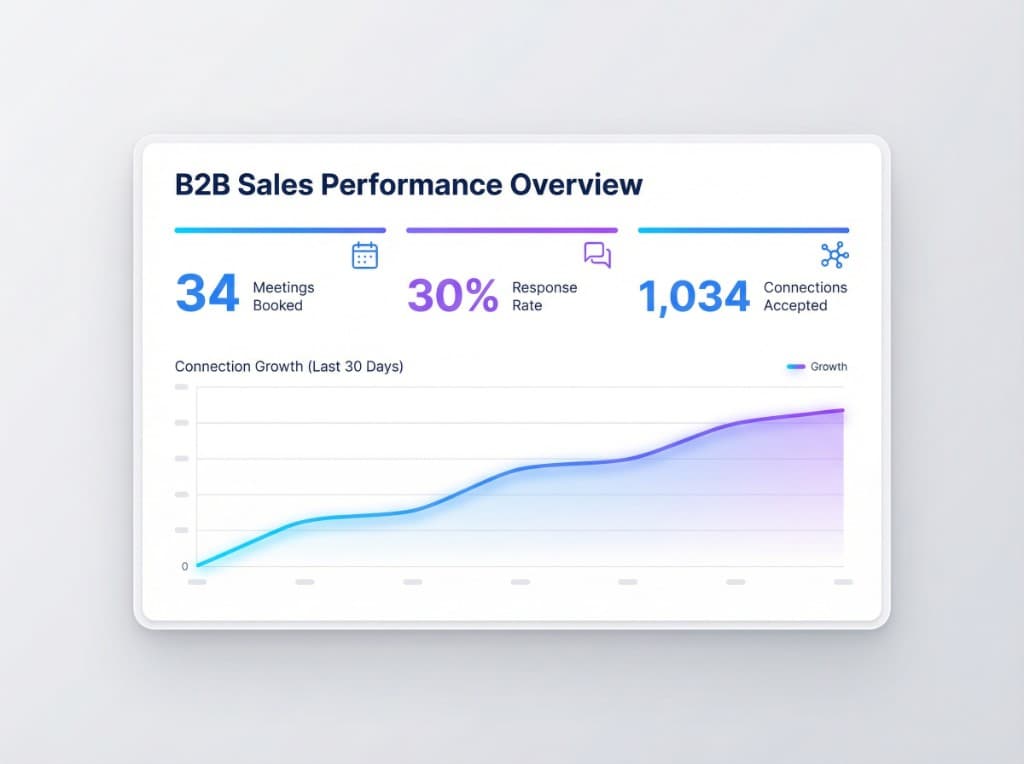
The numbers speak for themselves. With two active accounts, Barco Agency achieved 34 B2B meetings booked with decision-makers, a 30% outbound response rate, and over 1,000 new B2B contacts — all through prospecting handled entirely by artificial intelligence.
The first-contact acceptance rate reached 26%, well above the industry average, demonstrating that AI-personalized messages not only generate more responses but also build stronger professional relationships from the very start.
Why a founder with 25 years chose AI over SDRs
Ernesto doesn't make decisions lightly. With decades of experience managing SDR teams and knowing firsthand the challenges of the traditional model, his decision to adopt Theos AI was grounded in a direct comparison.
"I worked with many SDRs because we also offered that service," shares Ernesto. "I had diverse experiences. I met very talented people and also people who didn't adapt to the strategy, who didn't even understand it. I invested a lot of time. The best ones, the ones I dedicated a lot of time training, ended up leaving. That was very draining."
The comparison with Theos AI was decisive. The platform's speed in understanding and executing prospecting strategies far exceeds the months required to train an SDR. There's no staff turnover, no inconsistencies, and the cost is significantly lower.
"If this platform is reproducing almost perfectly what the SDR did, that's it, I don't have to think about it," summarizes Ernesto. "Plus the price is more affordable."
For other founders evaluating their growth options, Ernesto is direct: AI allows you to validate faster and with less risk.
"Theos gives you a tool as a founder to be able to start without having to hire that whole army of people, which means you can validate your offer much faster without having to risk as much."
Built by prospecting experts, not just programmers
Beyond the results, what impacted Ernesto the most was discovering that behind Theos there's a team that truly understands B2B prospecting. It's not a generic software tool built by programmers disconnected from the world of sales — it's a platform built by people who have lived the challenges of outbound firsthand.
"It's made by people who understand this," highlights Ernesto. "I realized from day one when we started talking that they know what it's about. You can tell they've done it themselves too."
The relationship with the Theos team — Gonzalo, Guido, and Rama — was a key differentiator. The support wasn't limited to solving technical problems; it included strategic guidance on how to maximize the platform's results.
"I consider that it's made by people who understand this," concludes Ernesto. "And that makes the difference. When the tool is designed by people who know about sales, you can see it in every detail."
0